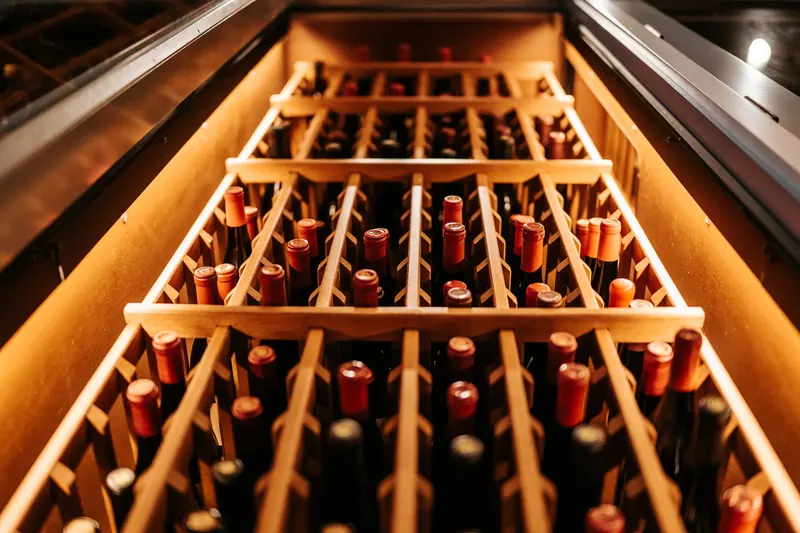
Climate-Controlled Wine Rooms & Cellar Millwork
An active cellar holds about 55°F and 60–70% relative humidity, every day of the year. That is a hostile environment for ordinary cabinetry — which is why cellar joinery is specified like exterior work, and priced above every other room.
- Per linear foot
- $1,000 – $3,000+
- Typical room
- $40,000 – $150,000+
- Environment
- 55°F · 60–70% RH
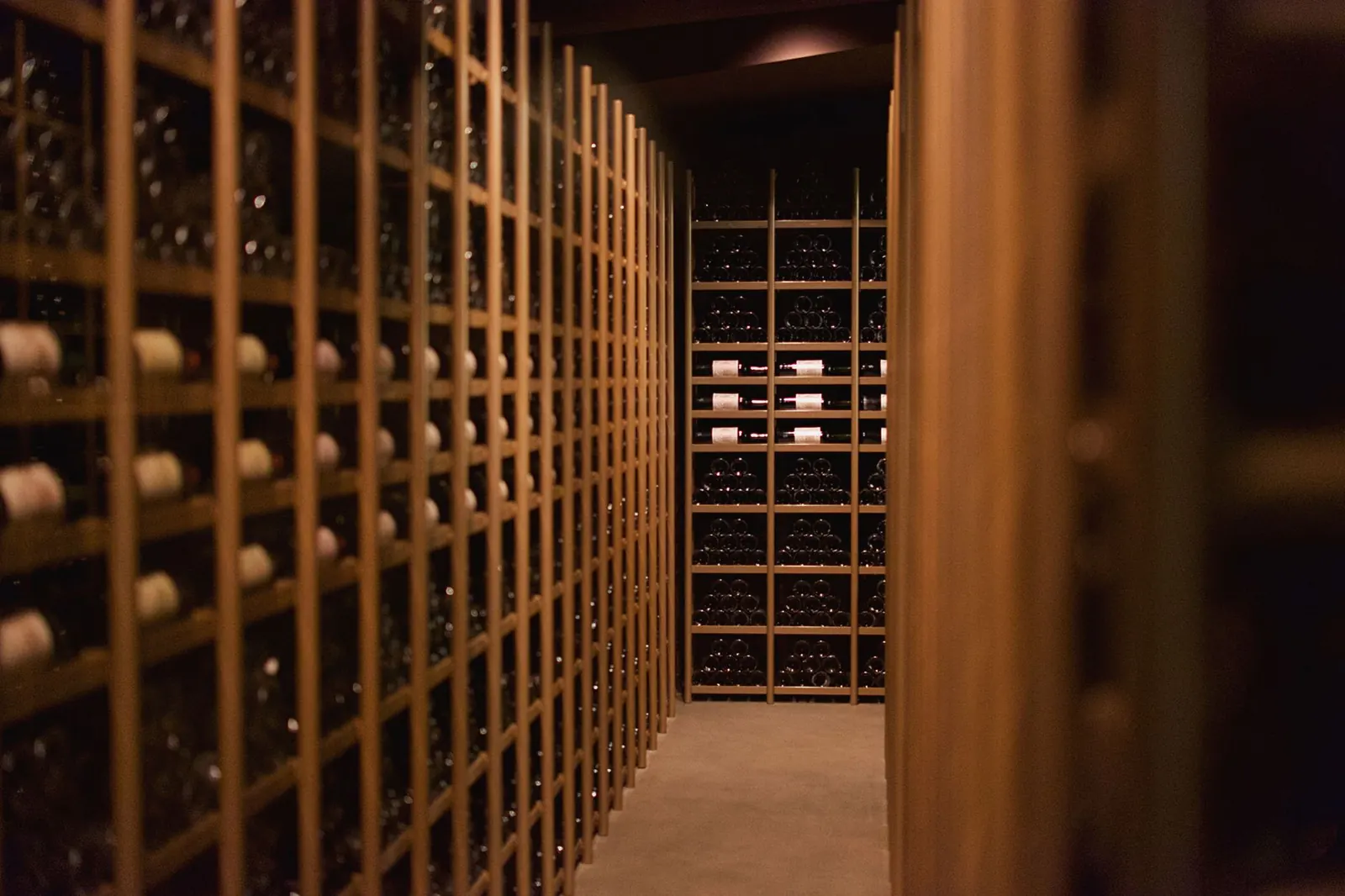
Moisture finds every shortcut.
MDF and particleboard absorb moisture at their edges and screw holes, swell, and lose their grip on hardware; in a sealed room with little air movement they can also harbour mould. Standard interior plywood delaminates over time if its glue line is not rated for humidity. Film finishes that suit a kitchen can trap moisture and odour against the wood.
Cellar millwork is therefore built from solid, dimensionally stable timbers, or from exterior-grade substrates with stable veneers; assembled with mechanical joints and water-resistant adhesive; and finished lightly — often unfinished inside the racks — so the wood neither smells nor sweats.
The room behind the joinery matters as much: a continuous vapor barrier on the warm side of the insulation, an exterior-grade door with a full seal, and a cooling system sized for the room's heat load. The millwork contract usually excludes these, but our brief coordinates them with your contractor and cooling specialist.
Which woods stay stable at 55°F and 65% RH.
| Timber | Stability | Odour | Character | Compliance |
|---|---|---|---|---|
| White oak Quercus alba | High; closed cell structure resists moisture | Neutral when unfinished | Pale to mid-brown, straight rift grain | CITES-free |
| African mahogany Khaya spp. | Very high | Neutral | Warm red-brown, ribbon figure | CITES II · timber |
| Honduran mahogany Swietenia macrophylla | Very high | Neutral | Classic deep red-brown | CITES II · timber |
| Thermally modified hardwoods | Very high; cell structure altered by heat | Neutral after curing | Darkened throughout, matte | CITES-free |
| Redwood (all-heart) Sequoia sempervirens | High; naturally rot-resistant | Faint, fades | Warm red, soft — dents easily | CITES-free |
Mahogany lumber and veneer of listed genera move under CITES Appendix II permits at import; your workshop should supply the documentation. See the CITES & Lacey Act guide.
Capacity per linear foot, by rack type.
Capacity depends on bottle format and rack depth. Figures assume a standard 750 ml Bordeaux bottle and an 8 ft rack height.
| Configuration | Approx. bottles / LF | Best for |
|---|---|---|
| Individual cradles, single deep | ≈ 18 – 21 | Labels visible; easy selection; the reference standard |
| Individual cradles, double deep | ≈ 36 – 42 | Duplicate bottles of the same wine |
| Diamond / X-bins | ≈ 40 – 60 | Case quantities; highest density |
| Magnum and large-format bays | ≈ 8 – 12 | Magnums, double magnums, Champagne |
| Angled presentation rows | ≈ 3 – 4 per row | Feature labels at eye height |
| Case storage cubbies | ≈ 24 – 36 | Unopened wooden cases |
Concealed cooling grille framing
Ducted split systems need supply and return grilles framed into the racking with clear airflow. We detail the grille openings, hinged access panels and condensate routes in shop drawings — they cannot be cut in afterwards.
Tasting table & display
A stone- or timber-topped tasting table, stemware hanging racks, a decanting ledge with low-heat lighting and a glass partition to the living space turn a cellar into a room. The estimator prices a tasting table as an option.
Why cellars cost $1,000–$3,000 a foot.
Solid stable hardwood throughout, hundreds of individually machined cradles, mechanical fixing to an engineered substrate, and coordination with cooling and vapor-barrier trades push cellar millwork above every other room. Racking density, species and the number of display features set where you land in the range.